June 13, 2000

Scary Old Man

Scary Old Man "The Twilight Zone" scared America silly in its heyday, primarily, if you look closely, with only slightly distorted images of ourselves, of the kind of people official, approved culture had made us, and of the kind of place America had become during the extended post-second world war boom. It offered the same kind of silly terror once upon a time available nearly everywhere in carnival funhouse mirrors: within the human grotesque one is invited to confront and recognize oneself as–horrors!–abnormal. 

These days, the Jerry Springer show and its like exploit much the same principle, presenting for our horror freakshow images of America, the people we have officially become and the fearful cultural landscape we inhabit in this, our current, post-cold war boom. But, unlike "The Twilight Zone," the latest TV carnival mirrors systematically subtract love. They free us and encourage us to hate, to boo and hiss in response to that creepy, skin-crawling feeling of self-recognition among the American grotesques paraded before us. Instead of preaching below the surface, as did "The Twilight Zone," that there is only one America, one human race, one common fate to which we, setting aside our artificially induced terror of difference, ought to be drawn in human compassion, Jerry Springer and company drive us further apart or, at best, into the legioned arms of  professional psychotherapy.

Whether or to what extent "The Jerry Springer Show" is in tune with America or America is being tuned by "The Jerry Springer Show," I’ll leave for you to consider as I present this little, "real-life" carnival mirror from one of America’s most telling of places, the California freeway. Needless to say, I ran across this bone-chilling tale the other day on America’s other most telling of places, the information superhighway. It’s written by an obviously nice, intelligent, young college woman, and is all the more scary for that: 

2000-06-12 18:45:38

Things are always interesting when I’m around. Serious. A half hour into the two hour drive to Oakland the craziness started. I went to point at something and a middle-aged man with a "going to molest and kill you" look thought I was pointing at him and got all smiley at me. For the next hour we kept randomly seeing him in the traffic. He’d drive by us smiling and we’d all scream. At one point he drove by with his hand up to his window making a peace sign. I’m still not quite sure what that was all about.

While all that was going on the three 13-year-olds who were with us saw a car with a couple guys and proceeded to wave and smile at them. The guys looked relatively young, 16 or 17, so we let the girls have some fun and try and talk to them. But since I was in the front passenger seat I was the one who had to try and talk to these guys while driving 65 mph. Very difficult to do, but we managed to give them Sarah’s cell phone number. They called later and Katie talked to them and made arrangements to contact them today or something. Turns out they were 21 and 18. Oh well, not like we’re going to arrange for them to go out or anything, and neither Sarah or I were interested.

I saw an amazingly cute guy in a blue car later who I got the attention of. The girls were all screaming and getting excited but Sarah and I calmed them down and instructed them that it was not the appropriate way to go about getting a guy. Unfortunately we lost the cute guy (and the scary old guy) when someone rear-ended us. We had to pull off and exchange information and all that. Didn’t look like any damage and Sarah’s car was going in for work from her last accident today anyway, but it still sucked.

I dread to comment, but I must confess that I find this hysterically funny. Yes, by now, you’ve probably guessed that, even as a kid, I laughed all the way through "The Twilight Zone." So did my parents. And I thank them now for the healthy example: the truth too horrible to be believed must be laughed at; named with terrible glee, with heartfelt joy that one is at least sufficiently free to recognize it for what it is rather than live and die comfortably deceived.

The most purely comic part of this contemporary freeway tale is Sarah and our narrator attempting to calm down the adolescent trio in the backseat with the advice of an elder, infinitely more experienced sister about "the appropriate way to go about getting a guy." This after leaning out the window exchanging cell phone numbers at 65 mph with one car of guys and flirting with yet another equally anonymous but "amazingly cute guy in a blue car." I’m sure the experience left an indelible impression on the backseat girls, just as I’m sure whatever passed for advice flew right out the window, along with Sarah’s number. 

Yes, of course it was all silly, safe, harmless fun on the way to an NSYNC concert…excepting, of course, the likely reason they were rear-ended. And there’s nothing more to be made of the story, unless you happen to be old enough to see a bit of yourself and your old friends in the funhouse mirror: "the scary old guy."

For guys, like myself, now over forty, the most hysterical, Twilight Zone part of the story is not that this car full of "girls" could enjoy creeping themselves out and screaming at the realization that a middle-aged stranger might smile and find them attractive. The most terrifying, funny part is the last line of our narrator’s account of that incident: "I’m still not quite sure what that was all about." Now that, the divide of naked incomprehension it implies, is scary, really scary, because it is so much America, today.

Objectively, it’s quite obvious "what that was all about." More than likely, unless you subscribe to America’s talk show image of the entire middle-aged male population, this car full of girls’ encounter with the "scary old man" was the most innocent, decently human thing that happened to them on the freeway that night. Just imagine, for suitable contrast, the testosterone tweaking thoughts pumping uncontrollably up and down the spines (forget the brains) of the young guys racing alongside–true romance, dear to every young girl’s heart. Based on what I can vaguely recall and still see of the typical 18-21 year old mental world within a world, they were lucky to be rear-ended only by another car. Certainly they got off easier in fact than in the minds and conversation of the young guys lost somewhere down the road. 

Yet it was the older face, at first absorbed in life’s many other, more complicated thoughts, that appeared to wear the media-fanned "going to molest and kill you" look in these young women’s eyes. And it’s nothing but creepy, with a surreptitious bit of superior, hateful, Springeresque pity on their part, when he goes "all smiley" on them. 

For that sorry, middle-aged man, however, the whole extended, chance freeway encounter with these young women most likely just got sillier and sillier as it went on and on–it’s simply and absurdly human to feel so young and so old at the same time–until finally he could think of nothing else but to smile and flash a now meaningless sign of community and togetherness: peace brother, peace sister. No doubt, he hasn’t had much occasion to do that in the last thirty years. "Da, da, da, da, da-da, Hope I die before I get old…."

As for myself, a member of the all but forgotten Sex Pistols generation, I’m too young to have ever flashed a peace sign in earnest to anyone, let alone to a car full of silly young women, but I understand my "elders" well enough to be joined to them by common human sympathy. And so I like to think this particular scary old man from the sixties went to bed sadly happy that night, and dreamed not of our young women breezing down the Y2K superhighway of life, but of other young women, long ago and far away, in another and increasingly distant century.

And now I have to go and cry a bit. Because I remember them too….and America as it ought to have been.


Unsentimental footnote: Of course, you reap what you sow. It was the sixties generation that first mistook “peace, love, and understanding” to apply only to those more or less the same age. Advertisers have been exploiting that mistake ever since.
June 11, 2000

$12000 Detention

I have noticed that the building at Fort Mason where I take my improv workshop classes is also home to the Waldorf High School. This campus on National Park land incorporates big, empty, white-wall rooms with cheap-ass posters of vacation spots and one room with a pink sheet on the door that says “Detention” and a list of the usual crimes that land a kid in detention.

It is that detention room that I can’t figure. Why would a school built on the premises of individual spiritual growth and independent learning need a 1950’s style detention room? This detention room has room for 30 students. The detention room for the students of my high school (population 1600) can only hold about 15 kids. I suspect that the Waldorf High School has about 100 students max.

The price tag for sending a kid to Waldorf High is 12,000 dollars. The teachers are not credentialed, but they have completed a 2 year Waldorf certification program (3 years if done on weekends).

The kicker is the Waldorf website. This is a monstrosity. Visit www.sfwaldorf.org. Perhaps I’m missing something, but where is there evidence that there are living, human kids at this school?

April 14, 2000

Outlaw Programming

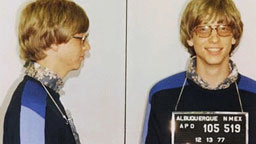
Bill Gates It’s tiny. It’s fast. It’s easy to find, download, install, and operate. It’s free. And unlike most software these days, it does everything its maker claims. For the moment, it holds the heavyweight title of the world, The Hottest Illegal Program on the Planet, for threatening to bring Hollywood to its knees. It’s DeCSS.
If you haven’t heard the by now old news, DeCSS is a ripper program, a DVD ripper. If you have a DVD drive in your computer, all you have to do is pop in a DVD, start DeCSS, and it automatically offers to copy any or all of the files on the DVD to your hard disk, in the process removing the copy protection that would otherwise prevent you from playing these files with any MPEG2-capable player. There’s no shortage of MPEG2-capable players.

Of course, once you have decrypted movie files on you hard disk, you’re capable of doing just about anything you and your software and hardware please with them: cut, excerpt and re-edit them; delete the annoying previews of coming attractions and language and subtitle files you don’t need; add bogus scenes and title credits of your own or from another film; dub in your own abusive soundtrack (a la Woody Allen’s first and perhaps most creatively funny film, “What’s Up Tiger Lilly”), recompress the movie with other codecs, including more efficient ones like MPEG4 (video) and MP3 or, better yet, MSAudio (sound), and you can top it all off by recording the results to another disk.

At present, DVD writers are scarce and expensive. Panasonic’s is the only well-publicized product on the market, and it’s priced at around $5000. Blank DVD disks are also pricey, more expensive than buying a pre-recorded DVD off the rack. So it’s not likely that an underground bootleg network is going to spring up, doing to DVD sales what MP3 is starting to do to audio CD sales…at least not this week. But Hollywood is looking ahead. Who can’t remember when CD burners were priced at $5000, even $10,000, and blank CDs cost more than pressed ones? No prices have ever fallen further faster.

What you can already do, and many are starting to do, is “backup,” as the euphemism goes, your store-bought DVD to VideoCD format, which uses the older MPEG1 “whitebook” standard and lower VHS-quality resolution to record video to cheap, inexpensive CDs readable by computer CD-ROM drives and most current DVD players. Documented in English or not, the capacity to read VideoCDs comes built into most DVD players because VideoCDs are an established alternative to VCRs throughout Asia. A VideoCD, or VCD for short, holds about 60 minutes of MPEG1-encoded material, so the average Hollywood-formula film will fit on two CDs.

Or, if you’re willing to abandon your antiquated boobtube entirely, and for entertainment plug yourself into the global corporate-media propaganda matrix on your 17, 19, 20, 21 inch computer monitor, you can use the hybrid “miniDVD” format, a creative patchwork of Microsoft’s MPEG4 and MSAudio. Redmond’s codecs are intended for streaming video, but you can crank up the quality and get excellent results off a CD. In fact, Microsoft compression is so good, that most Hollywood-formula films will fit on one miniDVD-encoded standard CD disk. Not what Gates & company intended, but there it is. And there’s more. If you still hunger for all the original DVD menus, options, languages, subtitles, director’s tracks, etc., some creative folks out there in netspace have developed a simple, text-based information file format and reader to make all the extras work with miniDVDs.

No wonder Hollywood is up in arms, and suddenly calling for what can’t help sounding like a global police state.

Take note: The issue is NOT piracy. Piracy, the theft and wholesale remarketing of trademarked and copyrighted property, is well established, the basis of a large part of the high-tech economy of countries such as Thailand, Indonesia, Hong Kong/China, and other places here and there around the “third world.” Pirated digital and audio CDs, and endless knockoffs of every other kind of brand-name consumer good have been black-marketed in America and elsewhere for decades. There have been pirate DVD’s from the start. The current uproar is fundamentally not about this kind of piracy, because what now threatens Hollywood profits also and equally threatens the large-scale, established pirate businesses throughout the world: the prospect of a global grassroots network of theft and distribution, with no centers of production or points of sale to target, where materials pass friend to friend, acquaintance to acquaintance, on and off the Internet, no money, no records changing hands. Consider that laptops are starting to appear with built-in CD burners: you can bootleg a CD over coffee with a stranger. With this kind of decentered, grassroots theft, the “enemy” rapidly disappears into and becomes synonymous with “the people”–thus the police-state overtones of the cries of anguish emanating from Hollywood these days.

Of course, all variety of technical schemes–encodings, encryptions, keys, hardware and software tracking ids, digital licenses–are already available to stop or, more truthfully, slow the emergence of this kind of grassroots network of theft and distribution. More will be developed. All will be tried. And you can argue until you’re blue in the face about how effective any will be and how dire the consequences if they don’t work. It’s hard to find anyone who can’t get quite worked up about the complications and implications. But behind the excitement, anger and anxiety, and driving the frenzy of discussion of this issue is a little fact no one wants to face, that the only real, debatable issue is “how long?” For any given scheme, how long before another little program like DeCSS gets out of the bag and can’t be put back? Because there will always be another DeCSS, and it will always be easier and cheaper to crack a protection or tracking scheme than to develop and implement one. There’s a general law operating here. Let’s call it the First Law of Digital Information:

First Law: Outlaw programming cannot be stopped.

Technical issues aside, there’s a another general law at work here that ought to receive serious consideration, because it overturns the basis upon which many have bet hopes and dreams and billions on the outcome of the “technology revolution.” It ought to be considered seriously, because the inevitable frustration of these hopes and dreams and billions is likely to lead, like the present cries from Hollywood, to pressure for poorly thought out, undesirable political/police solutions to what technology simply can’t in the long-run fix. That general law is a corollary of basic economic laws of supply and demand as they specifically apply to this Age of Information, where information of all sorts becomes ever easier to produce, distribute and consume. Let’s call it the Second Law of Digital Information:

Second Law: In any Age of Information, the market value of information rapidly approaches zero.

Evermore, everyone will be writing yesterday’s headlines. They may be good and profitable for a day, but after that you may as well kiss them goodbye and move on to the next. No royalties or residuals for creators. But, more devastating for corporate media, no “killer copyrights” that can be rolled on and on for years and decades off a single, original contract appropriating the work of content creators. Of course, the present media empires, Hollywood included, will not disappear, but it will be interesting to see how their game changes, for change it must.

It will also be interesting to see whether, as a consequence of the First and Second Laws of Digital Information, the much heralded “Age of Information” doesn’t turn out to be the shortest age on record; whether, as a consequence of our technology revolution, we don’t find ourselves instead embarked upon an “Age of Performance,” where only acts directly performed and reproducible by human beings, and only by human beings, retain any value.

In such an Age of Performance, for example, you may have to give up your rock star dreams of landing that multi-million dollar contract and, essentially, retiring to studio production and release tours every other year. But there may yet be a good living as a working and touring musician, pressing CDs as bootleggable advertisements for yourself and playing whatever you damn well please. The Grateful Dead did the equivalent for decades–no poor boys there. In such an Age of Performance, the need (if not the pay) for actors, directors, cinematographers will be as great if not greater than ever, but if you make it to Hollywood, just make sure that, like any of today’s digital porn stars, you get paid in full for your actual, on-the-job performance, upfront! Who knows, we may soon be able to look forward to an actual, rather than mythical revival of live theater….

April 13, 2000

Decimal Point Dyslexia

I keep misplacing the decimal point and make conclusions about quantities such that the fantastic to me is mundane and, the mundane to me is fantastic. I suppose this is best called decimal dyslexia.

For example, I had a hard time sleeping tonight, and I woke up, read a bit from a book titled "The Victorian Internet" about the history of the telegraph, let my mind wander, and felt compelled to rise up from my bed and check the financials on Yahoo!. First thing I noticed as I checked their 1998 10k is that the aggregate market value of their outstanding shares is 15 billion dollars. I counted all the places very carefully as I slid my finger across the screen under the number. After quickly scanning the description of their business, internet media thing, I scrolled down to the end where I found their financial statements (audited by Price Waterhouse who testify to the opinion that the statements are fair representations of the financial condition of the company) and noticed the following. Annual sales were 200 million, net income (they actually had a net income for the year) was 20 or 70 million dollars, Total assets valued at 600 million dollars.

Now the crazy thing is that Yahoo!’s biggest asset is the cash it holds in "investments" (about 500 million), that it’s contributed capital is about 500 million, and that it makes money from investment income. So, Yahoo appears to be more of a market fund account with high overhead, low returns (14 million) and is worth to the investing society as shown by the freely determined market to be worth 15 billion dollars.

I’m trying to scale this down so I can comprehend this. People are paying 15 thousand dollars for every 20 dollars Yahoo earns. People are willing to pay $750 to get one dollar of yahoo earnings.

See, my decimals are way off.

April 1, 2000

(De)Manifest of April Fools Day 2000

April Fools We are now living through one of those interesting, though hardly unique or remarkable periods in the history of human delusion when fundamental alterations in existing social, cultural, political and economic arrangements have become as unthinkable as they are inevitable.

It is not that signs of approaching disaster have gone unnoticed. They are sighted with increasing frequency every day. Ours is a time, for example, when a mainstream journal of international capitalism, The Economist, can review a publication characterizing the current structure of global financial markets as a “naturally occurring Ponzi scheme” and, while noting lapses in the author’s scholarship, entirely endorse his dismal conclusions. Yet available responses to this supposedly “natural” and, therefore, ultimately inexplicable and irresistible economic phenomenon seem to be limited to proceeding at exactly what we are doing either more slowly, according to some, or ever more quickly according to many more. Anything else, anything other, any possible change or rearrangement of the constellation of forces and purposes that led us here is simply unthinkable, simply beyond–the great gaping blank that hangs above, below, and haunts the in between of every bit and byte of that great incessant information flow with which our days and nights are inundated.

In the midst of a technological revolution in global communications, it seems that something as basic as understanding, the capacity to think something Other in the face of disastrous dilemmas, the capacity to imagine and discuss implications and consequences, and what might be done about them, is peculiarly missing, as absent from elite as from popular discourse. And it is this absence of understanding, the lack even of the capacity to notice that it has gone, that most characterizes our moment in human history and ranks it alongside other great delusionary periods that have preceded even greater Falls.

While we could debate forever the forces that make for and influence the timing of fundamental, radical, catastrophic change, and the debate is as long, as varied, and as fascinating as human history itself, we certainly don’t need to reach or to imagine any conclusion to this debate to grasp its import. Sudden, extraordinary transformations, true revolutions in human experience are a sufficiently regular feature of the history of every civilization and of the global history of relations among civilizations that we would be remarkable creatures indeed to have escaped, to be living already beyond any possibility of an end to the world as we know it.

Clearly, we have no compelling reasons, other than vainity, to believe we are such demigods. Rather, many of us now alive are more than likely fated, like so many mere mortal men and women before us, to live on and through the end of the world as we now know it. And we are less prepared, intellectually and emotionally, than any generation of at least the last 200 years.

Does no one else think it strange that we have just lived through the passing of a millennium, however artificial the dating, marked almost exclusively by the silence of millennial thought? How is it that no leader, no prophet, no poet, no priest, however elevated or degraded, emerged to paint promises of a bright new chapter in human history for all of mankind? For all the talk of an unprecedented “revolution” in microchip, telecommunications and biological technologies, what vast visions of the technological future were proffered even to begin to compare to the orgy of utopian thought placed before the public at the turn of the last century?

It seems our Technocrats are myopic, for the most they could manage to foresee was the single millisecond separating millenniums past from millenniums future. Our self-styled spiritual and political leaders did no better, saw no further. Silence. Silence reigned everywhere. Y2K was an anticlimax, because nowhere could anyone imagine anything to build up to it or to project beyond it. Absent any significant order of reflective or utopian thought, how could Y2K mean anything other than another tick of the digital clock.

And in America–as if we haven’t been speaking all along of America in the imperial mode of the self-imagined heir of all of “human history”–how do we set about electing the first President of this millennium? Can anyone imagine a greater pair of non-entities than Christian Bush and Gore, each born into a national political family and each deliberately chosen by his hereditary party’s strategists and funders long before the charade of primary electoral threats, duly dramatized, and duly met? Now that they’ve fully figured out how to render even national elections inconsequential for all practical purposes, what will they think of next? How will the fiber-optic cables and airwaves be filled with viewer-attracting photo-ops and sound bites between now and next November? The awesome impossibility of the public relations and media management task boggles the mind. Surely one or the other, probably Christian Bush, must be destroyed by devastatingly irrelevant scandal and personal revelations. Otherwise voter turnout might actually decline below the abysmal to dangerously revealing “why bother?” levels.

Whatever happens, the empty show will go on, as Shakespeare put it, full of sound and fury and signifying nothing. Evening newscasts, interviews of talking heads–clean-cut, pampered, white-faced, maled experts and pontificators of all totem colors and sexes–will drone on and on in increasingly screechy voices that betray a desperate underlying cry for attention to lines and themes and “issues” recycled year after year, decade after decade, with less and less conviction, and more and more genuine surprise that it can still be done, that the jig is not yet up. RealTV, Cops, Jerry Springer, and other parasitic infotainment flotsam will continue to drift to fill the void, with scripts written and awkwardly recited at reading comprehension levels so low even second graders should be embarrassed, serving up endless “real” images and “real” people, chosen seemingly to no other end than to degrade the mass of the viewing American public in their own eyes. It all as if to say, “See, we may not have the answers, but you cannot even turn to each other, to your neighbors, families, friends, co-workers, communities for help, for wisdom, not even for compassionate commiseration.”

And so we, too, must live on through this, our allotted moment in the history of human delusion. Many others have done it through equal or worse years, decades, centuries than these. How and when and what lies on the other side are questions that ought to concern us. But our situation is such that our first concern must be how, where and with whom are we even to begin, to begin to rethink thought, to pick up the pieces that make for understanding. How, where, and with whom are we even to reestablish the need for it?

And Why Bother?

Because in these times, there’s really nothing else to do… nothing that isn’t a stale diversion, delay, procrastination, and avoidance of that fundamental human task of understanding…except possibly to laugh, to laugh with friends, which is perhaps the most human and humanizing of all responses to the otherwise sorry human condition.

March 26, 2000

stupid people

American Beauty Ok, it’s Academy Awards night and Yahoo! news says the following:

LOS ANGELES (Reuters) – American Beauty, a movie about a dysfunctional suburban family trying to cope with life’s changes, won the Oscar for best film of 1999 at the Academy Awards on Sunday.

I have yet to understand how anyone can interpret American Beauty as a movie about dysfunctional families, suburbia and “life’s changes.” This is the essence of why American Beauty to me is a very bad movie. It is thematic mud, gorp, glock, or whatnot. It is a mumbling message attempting to quote Nietzsche that bumbles within its own medium and in the end gets interpreted as “I think the movie is saying that suburbia is bad.”

I also have a laundry list of other reasons the movie isn’t good, but just saying that it fails to deliver its message and is greatly misinterpreted, probably by its own writer and director, is enough to dump it.

Of course, it shouldn’t come as any surprise that it was heralded by the Hollywood industry, when its leading actress is the wife of Warren Beatty, who has his own weird message. Did anyone understand either he or Jack Nicholson in that twenty-minute tag team rambling marathon? The coke must be awfully good in LA.

I would like to weigh in and say that I think the most enjoyable movie I saw in 1999 was Star Wars. Then The Thirteenth Warrior. I’m tired of Hollywood industry “art” films. For massive state propaganda type movies, Hollywood needs to go back to Eisenstein and Leni Reifen-whats-her-nazi-last-name-anyway and their films.

Weighing in,
Disgruntled.

Now I need to see if Kevin Spacey’s portrayal of asshole, which came off as male bitch, was accepted as the best acting by a male star.

March 17, 2000

Operation Enterprise

The pace of the on-going technological assault upon privacy is dizzying. From every direction–local, state and federal government; business small, large, old and new, profit and non-profit–every animal, vegetable, and mineral that leaves the faintest information trail is now the target of ever more ingenious tracking, trapping, gathering, sorting, cataloging, profiling, data-mining and data-exchanging schemes.

And the already dizzy pace is only going going to pick up after the Y2K hurdle is cleared. The end of the world averted–their world, that is–legions of data-hungry institutions will be able to devote their full attention and the full power of their newly refurbished, Y2K-compliant, fully inter-networked, faster than ever data-crunching arsenal to pursuing the Great Hunt in which we and everything we have, want, see, hear, say, and do are no more than so much digital prey.

Not surprisingly, the most organized and articulate resistance to the assault on privacy can be found on Internet. Since the online and plugged-in are probably the most extensive and intensive users of information technology, they are also the easiest and most affluent prey in the digital forest, leaving information trails as broad as the proverbial "Information Superhighway" itself. Despite heroic efforts to discover and respond to the multiplying threats, even this most organized resistance barely manages to keep up with the assault on privacy that these days seems to race ahead of even the hardware-software revolution itself.

All the major privacy rights sites share a tone of breathless stridency and terror, as if aware that either no one’s really listening or if they are it’s probably too late. Start with the following short list, check them out. Read and follow their maze of links to other sites and endless documents. The "plot" will thicken. You, too, are sure to feel that creepy tingling of justified paranoia travel up your spine, lodging itself somewhere back behind your eyeballs, deep inside your skull, the one place where you can’t see. It’s not somebody that’s watching; it’s almost everybody.

Perhaps the most difficult challenge faced by privacy rights advocates in mobilizing themselves and the general public is deciding where to concentrate their energies and how to characterize the enemy. The assault comes from so many and such shifting directions, and there are seemingly so many unlikely heroes and villains changing places from moment to moment, that it’s easy to get lost and in doing so lose the means of realistically and effectively communicating the situation to the public at large.

For example, in the battle for secure, encrypted online communication for private citizens, major international corporations and especially banking institutions appear firm and powerful allies against the relentless quest of the domestic and national security state for a universal wire-tapping free fire zone. Yet, short of the courts, the federal government, particularly its administrative branch, is the public’s only potentially effective ally against the same corporate and, today especially, banking powers in their drive for universal, cradle-to-grave data exchange over every aspect of their customer’s lives. Of course, this is the same federal government that, in the processes of "reforming" banking law, is opening the door to the sharing of health data among insurers and lenders merged under the same corporate "roof."

Even the champions of privacy themselves are not excluded from this bizarre dance of heroes and villains, since privacy advocates have emerged as formidable opponents of national health care, which under any realistic scheme would require some form of recipient identification and database. Few of these digital-haves who champion privacy at the expense of universal health care bother to reflect that it’s only they, the affluent and well-employed who already have secure health care, who could possibly be scared to death by the prospect of being caught in the act of saving their own and their family’s lives. Those without would be fools not to take the trade-off as a good one. And the inability of the champions of privacy, particularly the ACLU, to see their own privilege is part of their difficulty in reaching the general public.

Another part of the difficulty in getting the message out about Big Brother, perhaps the largest part, is the legacy, the renown of Orwell’s 1984. Orwell’s Big Brother is the State. And that message about the danger of the State hits home in many countries around the world governed by various types of authoritarian, totalitarian, bureaucratic and closed oligarchic regimes. It also hits home in America, where presumably that State is constitutionally less of a threat, due to long-standing traditional suspicion, supremely exploited over the last two decades by Reagan and his right-wing heirs with their slogan, "Get Big Government Off Our Backs."

The problem with the slogan, the problem with the notion that "democracy means everybody taking care of themselves," is obvious, though hardly ever stated publicly, even by Democrats. Disempowering Big Government accomplishes little more than clearing the field for Big Business. The notion that democracy means everybody, from poverty-level single working mothers to a Bill Gates or a Donald Trump or, more powerful still, an AT & T or a Disney, each separately talking care of themselves as best they can without regard for each other, is patently absurd. Yet it’s the standard stuff of our corporate media-orchestrated political discourse.

The champions of privacy know that business databases are as great threat as any government database. But it’s a daunting task convincing average Americans that their precious freedom to shop with supermarket discount cards is only a ploy of Big Corporate Brother. As media pressure to "plug in" mounts, it’s even harder to convince them that they’ve a stake in concealing their browsing choices from new wave Internet marketing scams such as alladvantage.com, which pays users directly to keep adbanners and browsing-trackers on their desktop, or peoplepc.com, which offers a "free pc" and Internet access for $24.95 a month. Peoplepc.com, its operation and television ad campaign massively financed by Japanese venture capital giant SoftBank, has the gall to display as it’s corporate slogan the 1960’s anti-government cry "Power to the People." They might as well hang out a sign: "Orwell’s NewSpeak Spoken Here." But few would notice. By now most Americans, who were capable of outrage at Clinton’s obvious fumbling to conceal his tawdry Lewinski affair, don’t even register the scale of lying that comes their way through advertising. By now, commercials are just entertainment–"The Funniest Commercials You’ve Never Seen"–the way shopping is just something to do with your free time.


"Britain now has among the world’s highest number of CCTV cameras spying on its residents" ("London’s Big, Bad Brothers," Wired, October 19,1999).


In what is thought to be the city’s first Internet lineup of suspects, police posted 72 photos that were taken mainly by closed-circuit TV cameras. The suspects are wanted for inciting riots at the Carnival Against Capitalism on 18 June" ("Bobbing for Hooligans on Web," Wired, November 1,1999).


The following pages show photographs of:

  • persons wanted for offences committed on that day who are currently unidentified
  • persons who have been identified but not traced
  • those who have been arrested, charged with offences, released on bail and subsequently failed to appear at court

City of London Police

Electronic Privacy Information Center (EPIC)

interhack

Privacy Rights Clearinghouse

Privacy Journal

ACLU: Cyber-Liberties

Adbusters

Electronic Frontier Foundation (EFF)

Center for Democracy and Technology (CDT)

March 17, 2000

LDR, 25 Poems

LDR lives in Pacific Beach, California. This is a small sampler of her poetry.
(Copyright 1998, 1999, 2000. Reprinted with the author’s permission.)


1.

One man’s universal
epitaph
glorified in beams of
ruby,
gold,
& sapphire.

Lips painted of blood
speak of the narrow road
erratic
laughter
echoes through bays of embarrassment.

Tears
spurred by dramatics are
pulled
to show
Sunday conviction.


2.

You insist
that I lay on my back
using suave overtones to make a clean
incision.
How does it hurt?
Only so many bruises before the blood
rises to the surface,
smiling,
smearing,
insatiable hunger
keep jabbing
kicking me under the table
looking
always watching
for a tear
or fluxuating tone.


3.

Behind her eyes lay
cold steel truths
sleeping
awaiting her vulnerability
and it comes
creeping
silent panic
during lapses in conversation
or at night
after sex.

No sleep tonight.

They wait for closed eyes
paralyzing
don’t hurt me……
eyes snap open and
that field smell….


4.

Jean’s right.
It’s the cliches that do
all the harm.

We were drunk
merlot and
decoding love
letters carved into pumpkins.
Snuck away to walk you to your car
and one of us
broke the rules and
killed the secret
language we’ve been speaking to
each other.
We worshipped at the altar those 3 words have become
smashed every idol
and ate the offerings.

And you left me hungover.


5.

19
That’s the magic number
aware that I knew less than i thought i did
full of realism
I left him 6 times before I said
I do
6 times
before I had no other argument
than statistics


6.

I’ve been sitting up all night drawing you
on my body
My lips form the word
but sound doesn’t carry it to my ears
and the tears
have made their way down
traced a map on my belly


7.

I keep having this
dream
We’re in the bathroom
watching each other in the mirror
My teeth are falling out
you won’t catch them
the walls are moving
with flies and
I can’t move
my dress is too tight


8.

homesick…

I want you to know
that I’m here
thinking about you
and how
this isn’t my home.

I want you to know
about the sounds
my voice
how the electricity
went out.

I want you to know
how cold it is
and how the trees
hold the rain
and the leaves are turning.

I want you to know
about rotting apples
abandoned orchards
Mua’s camp
and the runaway boat.


9.

You’re right
I didn’t say I’m sorry
but I am
and that doesn’t matter now.
As though you made me
invite you to the party.
This has grown
ripe
and withered off the
vine.
Now
let go of my arms
and leave if that’s what you’re going to do.


10.

wow
he called again
and sounded really sincere.
he said….
I really wanted to say something that
I forgot to say earlier….
I just want you to know that
I am really going to miss hanging out with you
and that you are still
my favorite person and
I would hope that if you’re ever in a pinch that
you feel like you could call
me.
and that’s it….
no begging or pleading in
his voice.


11.

I was wrong
about being able
to lie on the phone
I can’t. I’m not even
going to try.
and you think you know me,
that I’m taking the easy
way out.

There’s a turn-
a missed beat
you’re striking out.
My voice found a solid line
2 feet back.


12.

it’s a prayer….isn’t it?

i seek absolution
through my experiences with women….
only my rosary isn’t in my hand….
it’s in my mouth….
which may be why
i’ve never let a woman go down on me.

Am i trying to heal myself
through those experiences….
am i even having an experience
with another woman….
or is it just me
that i’m praying to?


13.

I feel like a poodle
freshly shaved
Little pink ribbons
on all but my nave.


14.

Breath catches
in a flurry
of particulars
quizzical entries
in the journal of lies
Fearlessly observing.
Faith in her provisions
like that
in the Lilies of the Field
tempting hate
without a fight
tempting fate
without a vision.


15.

A night
of shadows dancing in
the foreground
two stars joined by the moon.
eyes met by casual recollection
lips touched in mirror image
of what could be…
and a small challenge
of what couldn’t.

With a simple ever-growing love
and faith in Him,
eyes grow wide in disbelief
and wonder of the
common occurrence
of miracles in our life.

So together….
hand in hand…

We explore one of God’s doors
to soar on the wings
of a familiar seagull and know
secretly we will always be
Peter and Wendy.


16.

I lied. panic
I look at you and think of all
I want for myself.
My eyes
too often betray that all I need
is to be held safely by
you.

Is this love?
the way you smell
the ocean in your skin
Am I in love because I’m
repulsed by the thought of being
with someone else?
or is it that I’m distracted
without you?

If I knew which way my heart
was burning
I could give you the ashes
or throw them away.


17.

Sparkling laughter
with every look
symphonies in synchronicity
dance with a touch
reality shifts
with every word
visions swim–
remembering past
knowing present
leaving dew
droplets of diamonds
waiting to be worn
and begin life in a T.V. tube.


18.

Fingers brush
cropped hair
masks shed
cleansed in tears
shaking.
For walls a lifetime spent
building
fall hard.
Gothic arches once
painted red
linger
memorizing
as they touch.


19.

in the news
children taken from
our world
drive by
fighting in the middle
east. children the
warriors–
parents?
The "big one" is
coming. California
will be another Atlantis
they say
there’s holes in the
ozone
we’re all getting
skin cancer
don’t drink the water
you’ll get hepatitis
The sky just fell…he’s
fucking some chick
from my old high school
and I’d like to vomit.


20.

So here I am
naked
to you
to the world
as I was to
the people in
Jack-in-the-Box
that morning
and all I can think
is how empty
my hand feels
without yours
how my eardrums
are shattering with the
silence of
one set of footsteps
and my pain wrenches
out
in tears coming
too easily.


21.

Little girl,
born 1 year ago
beautiful creature
You aren’t the first
your sister
did it too fast
and it hurt
became an old
woman at 16 full of
anger,
lies,
and fear.
lived with her
eyes closed.
and when they opened
she died
and you were born.
There is much of her in you
and that’s as it should be
for you are sisters
fruit of the same tree.


22.

Memories learned
stories told
pictures so dyed
from hearts unhealed
ornaments hung on
Thanksgiving.

Child clutching her
knees–laughter.
Such ignorance would
be wonderful
for a story’s ending.


23.

fallen to knees
wind blowing
carefully grown locks
soaked by tears
and rain
well-rehearsed
monologue long
forgotten
my heart took over
screaming
about love
loss
pain
you holding me
thinking
"this is all i wanted"
so
it’s been raining
ever since
because
at a loss for answers
you gave yourself
away
and now she has–
is
a piece of me.

So
at a loss for answers
kneeling once again
I gave myself to a rock
(as small as the world
and as big as alone.)


24.

these sequences
point and
counterpoint heralding
new beginnings
raising the dead.

raising the ante

spring cleaning. dust
bunnies in the albums
Lion too
but there are others
calling refrigerator-laundry

it’s all coming up green

again i hear
you. again I ask
for you to explain
what happened.
Pulling out eyelashes

dragging on the timeline

peppered with black
holes–


25.

Your clarinet sits under
my pillow
As I dream of days that I might
have been given the chance
to say
how
you
have changed how I love
to sing names and
you hang across my arms
words
thoughts
limp
when i hear certain songs
or work against crossword clues
Peanut butter & jelly
or stale McDonalds
reminds me of a green T
with no pocket
I wish I wouldn’t have
given back
to die with you.

January 16, 2000

Invisible Man

If you’ve read Ralph Ellison’s Invisible Man, post your comments for other readers.