
August 22, 2000

Margarita’s San Francisco Dream, 1998

Moving camera shots of moving subjects establish the limits of video-stream technology.

Not surprisingly, video-stream codec developers typically demonstrate their wares with talking head clips or variable frame-rate productions that amount to little more than stuttering slide shows. This kind of streaming may be of some use to CEO’s, pitchmen, news anchors, and other purveyors of corporate propaganda, but it fails even to test the threshold of a genuine "revolution" in mass media.

Since the dawn of cinematography, it has been understood that a uniform frame-rate is fundamental to the illusion of the "moving picture." The absurdity of variable frame-rate video is evident the moment one takes the camera from the tripod and stops shooting talking heads. Once camera and subject are put in natural motion, the use of variable frame-rate simply destroys any illusion of a "window on the world" by introducing unreal effects of apparent camera and subject acceleration and deceleration, keyed not to anything meaningful in the scene but to the sudden, accidental complexity of a momentary image being crunched.

It’s a sign of the times, of our current pandering to "fuehrer-ship" of all kinds, that such a thing as a variable frame-rate codec even exists. The only purpose served by variable frame rate codecs is to achieve more frequent synchronization between the lips of the star-icons we are meant to worship and the politico-cultural directives they utter for our consumption.

This 37k/sec WindowsMedia video stream was shot in 1998 by M. Baranova as part of an effort to test the acceptability of "video impressionism" as a potential populist medium–easy and inexpensive to produce and to distribute. Image "crispness" is deliberately sacrificed in favor of a "smooth" frame rate (5 fps for 56K modem reception). And image quality is further compromised for the "reality effect" of stereo sound.

We may not be "there" yet, but this is some distance along the road.

August 2, 2000

Baja, San Quintin

Baja, San Quintin To the left is VANITY…
And her name is MARGARITA.

She’s the reason I have very few pictures from a recent camping trip to Baja California, to San Quintin, except that she’s in them. I planned to photograph the place, the people, the wildlife, the incredible Baja sea and landscape. But every time I went for the camera, there she was. She pleaded. She insisted. She demanded. She jumped up and ran to get in the way. She stamped her feet and got very, very angry. It’s just that, from her perspective, any use of film other than on herself seemed an outrageous waste of time, money, and opportunity–her time, her money, her opportunity. She’s working on a set of photo albums for when she’s 80. So she can’t stand the idea of missing a chance, any chance, to see then what she looked like right now, and right now, and right now, and right now. Beauty fades with each passing minute….

Margarita is my wife, so I’m in no position to argue. Besides, there’s no arguing with Russian women once they’re set. "No" is meaningless, just an empty sign of some vast, vague and entirely irrelevant male conspiracy against all things that really matter, especially personal vanity, its endless accoutrements and attendant privileges. And since she’s also my venture capitalist, supporting me in whybother.org and other web adventures, who am I to say she can’t have a page or two of flattering photos of herself? Believe me, just starting to post these photos is already making my life much easier.

Three of us took a week off and drove down to San Quintin on a whim…Margarita’s whim, needless to say. Our friend Lucio (more recently “One must imagine Sisyphus happy” at My12Steps.com) had been traveling back and forth to Baja for some time, staying in various places and basically enjoying solitude, meditation, his books, and his writing. But as he was about to start another hermit stint, he made the mistake of hinting that Margarita might want to come along. She leapt for it, or maybe it was her hint in the first place. In any event, it would be a chance to realize her favorite English phrase since arriving in America nine years ago. "Let’s go… let’s go… let’s go." Somehow I suspect that’s her favorite phrase in any language.

Baja, San Quintin

Of course, there were complications. Lucio confessed he had second thoughts, half-wishing he hadn’t offered to take Margarita, assuming he ever really did. There was simply no way that going down to Baja with Ms. Letsgo was going to be either simple or peaceful. But there was no backing out. And so I had to go, too, for full measure and to serve as a buffer between Lucio’s dream of solitude and Margarita’s urge to go on and on and on. Nice solution all around, but before we came up with it we made the mistake of trying to talk her out of going, telling her there’d be absolutely nothing to do where we were going, that Lucio just wanted to play hermit, that she’d be bored. Of course, she didn’t believe any of it and got furious and hurt and furious again.

And in the end, she was right. She wasn’t going to be bored. She had her own plans for all contingencies. If nothing else, we could always photograph her, for which purpose she packed almost no clothing except a swimsuit, jewelry, pearls, and her favorite blue dress–her idea of camping gear.

Old Mill, Baja, San Quintin

So we went, the three of us in a Toyota Tercel packed beyond its limits. It was my first venture into Baja, despite having lived on the border for almost eight years and hearing endless stories of the place from everyone all around. My reluctance has been largely a matter of political sensibility. It’s not a question of feeling like a typical ugly American tourist. The three of us traveling together were hardly typical. Getting visas and crossing the border either way was hysterically cosmopolitan, what with a Nicaraguan, a Russian, and an American with a Cuban-Basque first and last name cramped in the same little Japanese car.

My reluctance arises from having to confront directly not only the symbols but the reality of my life and imperial citizenship at the center of a global power structure. At the Mexican Consulate, the Nicaraguan got a one-month visa, the Russian got a three-month visa, and the American without even a passport got a six-month visa. And then there are the mirror "Check Point Charlies": one sixty miles north of the border past Oceanside, surrounded by a massive US military base, tanks and helicopters always raising dust to the right and left; and the other sixty or so miles south, right past Ensenada. The scenery is beautiful, but it can’t sufficiently hide naked geopolitical realities.

Sand Dunes, Baja, San Quintin

The difference between the mirror Check Point Charlies is the difference between clean cut, smartly uniformed if slightly sinister INS officers on the American side and, on the Mexican side, lounging, unshaven, generally brutal and brutalized kids in full fatigues, sporting heavy caliber automatic weapons. It’s the difference between an empire, America, that masks from its own citizens the naked power it musters to use against peoples elsewhere around the world, and a imperial colony, such as Mexico effectively is, in which military might serves only one real purpose, the pacification of the domestic population.

As a Nicaraguan citizen in exile, Lucio stiffened at the wheel every time we passed a convoy of trucks and armored vehicles. And we passed them often. I couldn’t help thinking of Chiapas, and feeling unexpectedly Cuban. Margarita was indifferent. She grew up in Russia and came to America before the fall of the communist state. Daughter of an auto mechanic and a cafeteria worker, a genuine and genuinely spoilt "proletarian," she’s the kind of Russian now nostalgic for the Breshnev years and, therefore, completely at ease with a military serving both internal and external imperial functions.

Clams, Clamming, Baja, San QuintinIn truth, Lucio and I probably envied her unshakable equilibrium, her seemingly innate, survivalist assumption that all politics is irredeemable bullshit and, at worst, a petty annoyance to the real business of life. Nothing will ever change. "Let’s go…."

In San Quintin, the real business of life was sunning, clamming, fishing, eating, and, of course, photographing Rita doing all of the above before she turns eighty the day after tomorrow. Accidental tourists, we stumbled onto the clamming. We didn’t know, but the beaches there are quite famous for them. All the local restaurants serve them, but the best are to be had from the roadside stands set up for nothing but that purpose. If you make the mistake of stopping, you end up staying for an hour, asking the guys who work the stands to split just another and another and another. And they laugh all along, because once you’ve stopped, they’ve got you hooked.

It was David who told us about the clams, or rather showed us, showed Margarita first, because he’s only starting to learn English and, though pronouncing perfectly what little he did know, proved to be quite shy about it. David was the 19-year old chef at the local resort-campground where we stayed. A first-rate cook and a charming, impossibly nice kid, he’s not a local. Like so many other Mexicans in Baja, he’s there from elsewhere for the work, for the boom times that have come with development for American tourists and expatriates. David’s on a career path. He’s broadening his menu and his English. He’s good enough at both, at 19, that he’ll work his way through the Mexican resorts along the Baja coast, moving always north. Someday, if things go his way, he’ll be cooking Italian, French, or hybrid California cuisine in some up-scale restaurant in San Diego, LA, the San Francisco Bay Area. He’s shy now, but it’s easy to see that he’s got the talent and focus to get there.
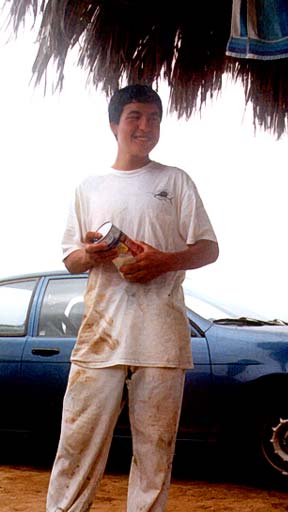
Baja, San QuintinOr at least it’s nice to think so. There’s no life path that isn’t really a long series of unexpected detours to outcomes one never could have anticipated.

In any event, David adopted us, as he no doubt adopts any group of Americans who prove friendly and unpretentious, for the English he could pick up and for news about food and cooking in America. Lucio was a great catch, in this respect, not only speaking English and Spanish but also having spent a good many years as a waiter in top-flight Italian restaurants. And we, as pathetic and disorganized car campers, were definitely in the unpretentious class. As a result, we ate very well. David brought a bit of the best of each night’s menu for us, or rather for Lucio to try, and in the end he was pleased to walk away with a can of Campbell’s (How awful is it?) and a can of tuna, with advice on how to read the English label for "solid white, in water."

In addition to clamming, we tried fishing, or rather Lucio tried. Margarita and I had no dreams of the perfect Baja beach existence to drive us on, so we stuck to watching. But Lucio waded right in, at least as far as his always lit cigarette would let him go. Actually, that was where we first met David, not at the resort. We found him down in the waves, the first afternoon we were there. He saw Margarita excited by the tiny clams she was finding washed up by the surf, and dug down to show her how big they really were if you were willing to get totally sopped. Lucio came along and saw David’s fishing gear: a line, with regular weights and hooks, wrapped around a makeshift beer-bottle casting reel. It reminded him of similar wooden spool ones he had used in Nicaragua, but improved by the slickness of the bottle, which allowed the line to fly off more freely. So the next day we were back, together on the beach, with a fresh set of weights and hooks Lucio bought for himself and David, and bottle spools David provided, lines cut to the right length and already wrapped.

Surf Fishing, Baja, San Quintin

The basic trick of fishing with this gear is simple enough, although it requires a bit of practice to get it right. You have to whirl the baited and weighted end of the line over your head with one hand, and then release it at just the right moment so that it sails as far as possible out to sea, pulling the line off the butt end of the beer bottle, grasped by the neck in your other hand. There’s also a timing issue with the bottle, which must be pointed up and seaward at just the right angle for the moment so as not to drag the sailing line back in mid flight. Then you wait. Then you reel in, wrapping the line around the bottle to start again. Of course, since it’s true Fishing by any name, there’s endless room for fruitless speculation and mythologizing about the ideal number and size of weights and hooks, and their distribution on the end of the line. And then there’s the issue of bait, in this case a choice between old fish from the resort kitchen or bits of clam fresh from the beach.
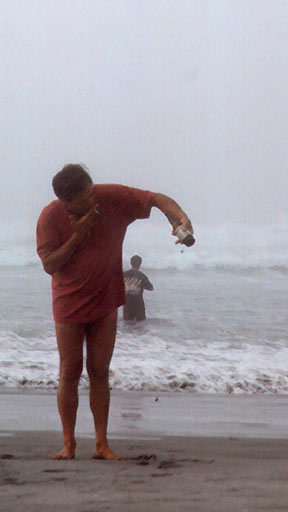
Surf Fishing, Baja, San QuintinFor two consecutive days, they got very, very wet, and caught absolutely nothing. But it was "good fishing" nonetheless. We ate the clam bait.

It was all like that. Everything that happened, happened fortuitously. We planned nothing, except how to get there, and even that we didn’t do very well. It took us four hours just to clear Tijuana, because we wandered around in circles, through the peripheral American-style shopping malls that have sprung up outside the center of town, looking for a bank authorized to take our token visa-travel payments and stamp our papers. It was a new scheme to grab a few more dollars from border-crossing adventurers, and most of the banks hadn’t the slightest idea they were on any list or why. But the tellers were all very amused by it, by the scheme, and we would never have met them nor negotiated so many truly devious mall parking lot mazes, but for the new travel requirements.

If you want to see what American mall parking lots would look like if developers here dared, just take a ramble through Tijuana’s mall lots. You can get in, but just try getting out, before or after you’ve paid for the privilege.

In any event, everything was fortuitous. We eventually arrived at our campground and, aside from trips to town to buy food and look around, we never left. Everything, everyone, and every creature came to us. Preceding David, the first night we were discovered by the resort’s watch dog. An old, bedraggled beast, he was very polite and very cautious about approaching us. We had sympathy until we found out why, when he snagged two sandwiches right out of the trunk of our car the moment our backs were turned. He did give them up, when confronted. But he probably also knew from experience that by then it was too late, that we’d likely hand them right back rather than eat them ourselves. Which we did, and firmly established that as the basis of our relationship for the duration of our stay.

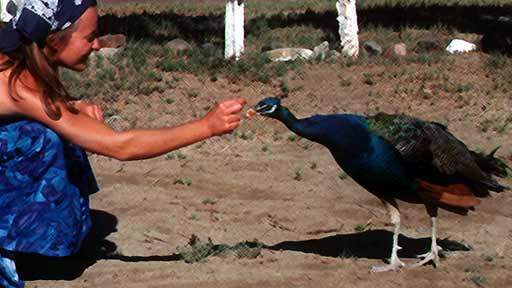
After that first night, the word apparently got out, and all the resort’s residents made their way over to our campsite, except the goats because they were chained up. The most spectacular, were the two peacocks.
Camping, Baja, San Quintin

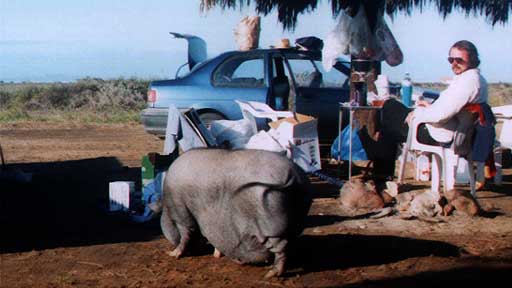
They ate just about anything and competed with Margarita for photo-ops. We were also visited by a mismatched pair of puppies, brought by David and the resort owner’s ten-year old granddaughter. She came on a bicycle with training wheels, speaking perfect English and Spanish, with lots of questions. We concluded she was a self-appointed spy: her mission to learn everything she could about us and about what David was doing hanging out with us. She immediately preceded our most imposing and intimidating visitor, "Porky," a large, old, and not easily moved or removed Vietnamese pig, with two huge tusk teeth.
Camp Site, Baja, San Quintin

As Porky slowly approached a hue and cry of contradictory warnings marked his progress. Don’t feed him! Don’t NOT feed him! Make him go back! Don’t stand in his way! Apparently, Porky, in his old age, had become very cantankerous, easily angered and easily offended by anything that even hinted at an impediment to his moment by moment desires. (Somehow he made me think with dread about what Margarita will be like at 80, when she finally starts to look at those photo albums.) Fortunately Porky had one great weakness: grapes. Threats and prods with a baseball bat had no effect, but he could be moved anywhere by leading the way and repeating, "Porky. Porky. Grapes. Grapes, Porky. Grapes!" After half an hour of that things settled back to normal and we could enjoy what food we had left.
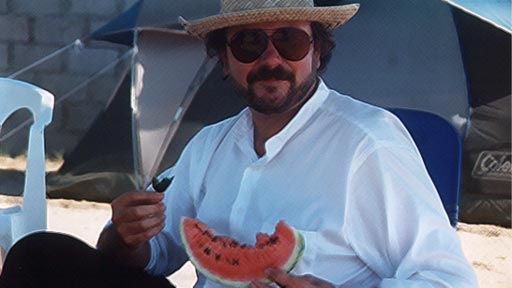
Watermelon and Jalapeño, Baja, San Quintin

Our last visitors arrived the afternoon we left, after a brief morning downpour, which had been threatening for days and had been responsible, according to the locals, for the extraordinary number of flies about during that time. Seems there was some truth in that. At least, when the storm finally came, the flies all magically disappeared. The rain was beautiful, raising little clouds of dust everywhere the enormous raindrops exploded upon the otherwise dry, cracked dirt. Margarita and Lucio took shelter in the tent, but I sat outside, under our campsite cabana, as the storm blew through. Afterward came our last visitors: hundreds of "stink beetles," as I grew up calling them, which appeared out of the same nowhere into which the flies had vanished, the moment the rain had stopped.

It’s a pleasure to discover, once again, that nature’s movements are still vast, indifferent to technology, capable of driving man, beast, and all other species before them. And on that note, we packed up and drove off into the not-so proverbial sunset.
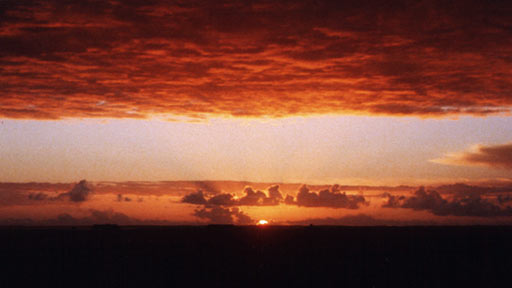

Sunset on the Beach, Baja, San Quintin

June 13, 2000

The Shape of Webs To Come

Self-Organizing Systems The most recent attempts to measure the Web’s dimensions (May 2000) have produced not so much interesting results as a new wave of metaphors to “naturalize” the predictable effects of mass media advertising, specifically the last two seasons of site-pumping TV ad campaigns.

Of course, the number of web sites continues to grow exponentially. So does the number of “pages,” although with so much custom and even ordinary HTML output now created on-the-fly by n-tier database systems, the concept of “pages” is outmoded and “total pages” is a purely speculative measure. Search engines don’t even index this massive on-the-fly content, and they don’t yet read XML. But even omitting this kind of content, the Web is booming. No surprise to anyone.

Neither should it surprise anyone that present growth in web traffic is increasingly confined to fewer and fewer sites. That’s what advertising and PR are supposed to accomplish. And the professionals who are very well paid to do it know their business. They’ve known it since the birth of mass media marketing in the early decades of the last century, when the science or art — whatever it is — was still called by its proper and more descriptive name, propaganda.

That early twentieth-century discovery is elegantly simple: If you have the right media tools and a sufficiently fragmented, disoriented population, fearful, anxious and confused by modern life, you can discover, by hook or by crook, effective techniques of propagating an idea, a symbol, an icon, a value, whatever, such that it enters mass culture and takes on a life of its own, reverberating in the vast emptiness of the popular psyche, its presence growing, amplifying beyond anything in your power to communicate directly. How many of us can still hum and sing the jingles of our childhood? “It’s Ellis Brooks, today, for your Chevrolet, corner of Christian Bush and Van Ness….” That one cut so deep in the San Francisco Bay Area, that, last time I looked, Ellis Brooks sprawled for blocks, and if it weren’t for the original sign still hanging, you’d be hard pressed to find the Chevy showroom among all the Ellis Brooks imports.

Propaganda works. No surprise, especially since it contributes to the further growth of the underlying conditions upon which it depends: cultural fragmentation, disorientation, fear, anxiety, confusion. I’ve never bought a Chevy — never would, never will — but that junk is still rattling around in my brain as if it were important, essential to my life experience; as if it were a treasured piece of accumulated wisdom I would wish to pass down to future generations.

No surprise. So why all the buzzing excitement over the recent web surveys and academic and think-tank analyses that only rehearse what we all know so well, that with mass media ad campaigns a few sites can dominate an exponentially growing field of competitors? In part, the excitement, no doubt, stems from relief. Thank God, it still works! Thank God, the principles remain fundamentally unchanged despite this new medium’s relatively low barriers to entry. The alternative — everyone can enter, and there’s no way to achieve dominance — is just too scary, too populist, too… well… democratic.

To understand the role played by relief in the excitement, you have to take note that the major marketing executives and strategists dedicated to pulling off this stunt of rendering most of the Web effectively invisible to inexperienced users have worked most of their lives in a media economy of scarcity. They have worked and planned around technological and legislative limits on the number of media outlets: there have always been relatively few radio stations, even fewer TV broadcast licenses, and only a handful of networks controlling them all. You need a knowledge of history, to go back to Lenin, Mussolini and Hitler’s early experiences with leaflet and other print materials, to have confidence that well-designed propaganda’s effectiveness does not utterly depend upon having a media monopoly — not that Lenin, Mussolini and Hitler each didn’t know how to use a media monopoly when they finally got one. The glee of relief can only come to those who have no sense of history; to those who forget the past; to those who, for obvious reasons, probably cannot acknowledge even to themselves the path-breaking experience and truly creative genius — call it “evil genius” if it makes you feel better — of the founding, grandmasters of their discipline.

“Naturally,” the new wave of academic metaphors to conceptualize the Web phenomenon also serves to conceal the obvious, that the shape of the Web we now see results from very particular and deliberate human planning and effort. “The more pages a site has, the more likely it is that more pages will be added to it,” one of these academics says, “It’s just like the growth of a tree.” Neither of the studies being cited around the Web, (e.g., MSNBC’s “Measuring the Web’s Diameter”), takes the least note of the phenomenal boom in dot.com advertising on radio, TV, billboards, magazines, newspapers, books, etc. It’s as if Notre Dame physicist Albert-Laszlo Barabasi and his colleagues, Reka Albert and Hawoong Jeong, authors of one of the cited studies, and Bernardo Huberman and Lada Adamic of the Xerox Palo Alto Research Center, authors of the other most frequently cited study, were all living on another planet where the only medium available were the Internet. They evidently did not watch either of the last two Superbowls, when millions per minute were dropped to influence web traffic patterns, to say nothing of what every major player has been spending on a weekly basis ever since. Perhaps they are so dedicated to their studies that they don’t even own TVs.

But more likely their studious silence on the obvious intent and impact of mass media propagandizing of the Web results from the inconvenient fact that noticing it would spoil the neatness of their theoretical model, which depends upon the Web being a “Self-Organizing System,” or “SOS” for short-“just like a tree” or, more correctly and encompassing, just like a rain forest ecosystem.

According to USENET’s SOS FAQ, “Many natural systems show organization (e.g. galaxies, planets, chemical compounds, cells, organisms and societies)” of the self-organizing variety. Investigation of self-organizing systems is particularly hot right now in ecological studies, applied to the rise, evolution and extinction of species that cohabitate within local and global ecosystems, and in astrophysics, applied, among many other things, to the theoretical distribution of planetary solar systems like our own in the universe as a whole: “The forms we identify around us are only a small sub-set of those theoretically possible. So why don’t we see more variety?” So, of course, it’s tempting to take the metaphors seriously and apply the same model and mathematics to the “ecology” of the Web “universe.”

But here’s the kicker, the definition of SOS and the premise upon which the currently cited studies of the Web are based: “The essence of self-organization is that system structure often appears without explicit pressure or involvement from outside the system”; evidence of self-organization is “the evolution of a system into an organized form in the absence of external constraints.” In terms of the field’s own definitions, the idea that the Web is a self-organizing system, especially that Web traffic patterns are self-organizing, “without explicit pressure or involvement from outside the system,” is monstrously absurd.

But nowhere in the recently publicized studies nor in any of the collateral web documents I have searched is there even a hint that there might be a problem, or at least one worth considering. Instead, we are told that “the Web has taken on an organic life of its own,” “follows natural laws and can be studied as ‘an ecology of knowledge,'” because, as a self-organizing system, the Web “exhibits the type of physical order found in, say, magnetic fields, galaxies and plant growth.”

Of course, there’s nothing new about the use of nature metaphors to terminate social and political inquiry into historical phenomena. The notion of the unquestionable rightness of “the survival of the fittest,” as an apology for inequitable distributions of wealth, health and happiness under capitalism, predates Darwin’s borrowing of the metaphor to explain the planless patterns of natural selection, but Darwin’s theories were quickly reimported into social and political discourse to perpetuate, with greater scientistic glory, the same aggressive anti-poor campaign on behalf of burgeoning corporate and financial power during the peak of the industrial revolution. Now, on behalf of the primary beneficiaries of the information-media revolution, the science of self-organizing systems provides a convenient “natural” rationale for not sending up an SOS over the virtual extinction of traffic to Internet sites that cannot afford major media advertising.

As if that weren’t bad enough, these recent studies have been taken, in a leap of logic I cannot fathom for the life of me, to justify new “intelligence search techniques that can adroitly skip from site to site, seeking out the most relevant or most popular sites within the Web behemoth.”

Search-engine companies already are relying increasingly on such techniques, said Danny Sullivan, editor of Search Engine Watch. He said that’s the rationale behind search sites such as Google, which ranks its results by link “importance” … DirectHit, which bases its analysis on “what people are clicking on” … and Inktomi, which is “looking at what people are actually viewing.”

Note that in the preceding quotations, as throughout professional discussion of these matters, it’s hard to tell what “relevance” or “importance” mean, aside from serving as synonyms for “popular.” Perhaps “relevance” and “important,” if different at all, are the special categories reserved for soon-to-be-popular content owned by the media giants that, increasingly, are buying up established search engines to create vast integrated marketing (a.k.a., progaganda) apparatuses, spanning print, radio, TV, film, video, DVD, and the Net.

In any event, it’s not hard to discern the self-fulfilling prophecy here. Mass media ad campaigns produce the concentrated traffic patterns that allow “scientific” studies of the Net to declare the operation of an entirely “natural power law distribution” in an independent “self-organizing system,” which in turn calls for search engine traffic direction concentrating user attention upon what is already popular, that is, upon what has been or is being marketed by the traditional mass media. There may be signs of a self-organizing system here — one well worth studying — but it is the media apparatus as a whole, to which the Web appears to be growing increasingly subservient, less and less self-organizing.

But we may confidently expect no publicized studies of the overall media apparatus as a self-organizing system, because that wouldn’t be “scientific.” It would be radical politics. For such a study couldn’t help but send up an SOS potentially calling forth “external forces” — those of us now passive consumers of mass media culture — who might very well object to the “power law” the media have achieved over American and global individual and collective consciousness if we saw it too starkly and directly in its “ecological” totality.

Ironically, it is only the academic and scientific community, out of which these legitimations of de facto media marketing power over the Web have arisen, that has complained about its obvious consequences: “importance” and “popularity” too rarely coincide. The new “intelligence search techniques” are inevitably skipping over academic and scientific sites as of no “relevance” to anyone.

Naturally, they’re asking for government funding to remedy the injustice of this “natural” omission.


See MSNBC: “Measuring the Web’s Diameter” and MSNBC: “Web Growth Outpaces Search Engines” for source of quotations and background information used above.

June 13, 2000

Scary Old Man

Scary Old Man "The Twilight Zone" scared America silly in its heyday, primarily, if you look closely, with only slightly distorted images of ourselves, of the kind of people official, approved culture had made us, and of the kind of place America had become during the extended post-second world war boom. It offered the same kind of silly terror once upon a time available nearly everywhere in carnival funhouse mirrors: within the human grotesque one is invited to confront and recognize oneself as–horrors!–abnormal. 
These days, the Jerry Springer show and its like exploit much the same principle, presenting for our horror freakshow images of America, the people we have officially become and the fearful cultural landscape we inhabit in this, our current, post-cold war boom. But, unlike "The Twilight Zone," the latest TV carnival mirrors systematically subtract love. They free us and encourage us to hate, to boo and hiss in response to that creepy, skin-crawling feeling of self-recognition among the American grotesques paraded before us. Instead of preaching below the surface, as did "The Twilight Zone," that there is only one America, one human race, one common fate to which we, setting aside our artificially induced terror of difference, ought to be drawn in human compassion, Jerry Springer and company drive us further apart or, at best, into the legioned arms of  professional psychotherapy.

Whether or to what extent "The Jerry Springer Show" is in tune with America or America is being tuned by "The Jerry Springer Show," I’ll leave for you to consider as I present this little, "real-life" carnival mirror from one of America’s most telling of places, the California freeway. Needless to say, I ran across this bone-chilling tale the other day on America’s other most telling of places, the information superhighway. It’s written by an obviously nice, intelligent, young college woman, and is all the more scary for that: 

2000-06-12 18:45:38

Things are always interesting when I’m around. Serious. A half hour into the two hour drive to Oakland the craziness started. I went to point at something and a middle-aged man with a "going to molest and kill you" look thought I was pointing at him and got all smiley at me. For the next hour we kept randomly seeing him in the traffic. He’d drive by us smiling and we’d all scream. At one point he drove by with his hand up to his window making a peace sign. I’m still not quite sure what that was all about.

While all that was going on the three 13-year-olds who were with us saw a car with a couple guys and proceeded to wave and smile at them. The guys looked relatively young, 16 or 17, so we let the girls have some fun and try and talk to them. But since I was in the front passenger seat I was the one who had to try and talk to these guys while driving 65 mph. Very difficult to do, but we managed to give them Sarah’s cell phone number. They called later and Katie talked to them and made arrangements to contact them today or something. Turns out they were 21 and 18. Oh well, not like we’re going to arrange for them to go out or anything, and neither Sarah or I were interested.

I saw an amazingly cute guy in a blue car later who I got the attention of. The girls were all screaming and getting excited but Sarah and I calmed them down and instructed them that it was not the appropriate way to go about getting a guy. Unfortunately we lost the cute guy (and the scary old guy) when someone rear-ended us. We had to pull off and exchange information and all that. Didn’t look like any damage and Sarah’s car was going in for work from her last accident today anyway, but it still sucked.

I dread to comment, but I must confess that I find this hysterically funny. Yes, by now, you’ve probably guessed that, even as a kid, I laughed all the way through "The Twilight Zone." So did my parents. And I thank them now for the healthy example: the truth too horrible to be believed must be laughed at; named with terrible glee, with heartfelt joy that one is at least sufficiently free to recognize it for what it is rather than live and die comfortably deceived.

The most purely comic part of this contemporary freeway tale is Sarah and our narrator attempting to calm down the adolescent trio in the backseat with the advice of an elder, infinitely more experienced sister about "the appropriate way to go about getting a guy." This after leaning out the window exchanging cell phone numbers at 65 mph with one car of guys and flirting with yet another equally anonymous but "amazingly cute guy in a blue car." I’m sure the experience left an indelible impression on the backseat girls, just as I’m sure whatever passed for advice flew right out the window, along with Sarah’s number. 

Yes, of course it was all silly, safe, harmless fun on the way to an NSYNC concert…excepting, of course, the likely reason they were rear-ended. And there’s nothing more to be made of the story, unless you happen to be old enough to see a bit of yourself and your old friends in the funhouse mirror: "the scary old guy."

For guys, like myself, now over forty, the most hysterical, Twilight Zone part of the story is not that this car full of "girls" could enjoy creeping themselves out and screaming at the realization that a middle-aged stranger might smile and find them attractive. The most terrifying, funny part is the last line of our narrator’s account of that incident: "I’m still not quite sure what that was all about." Now that, the divide of naked incomprehension it implies, is scary, really scary, because it is so much America, today.

Objectively, it’s quite obvious "what that was all about." More than likely, unless you subscribe to America’s talk show image of the entire middle-aged male population, this car full of girls’ encounter with the "scary old man" was the most innocent, decently human thing that happened to them on the freeway that night. Just imagine, for suitable contrast, the testosterone tweaking thoughts pumping uncontrollably up and down the spines (forget the brains) of the young guys racing alongside–true romance, dear to every young girl’s heart. Based on what I can vaguely recall and still see of the typical 18-21 year old mental world within a world, they were lucky to be rear-ended only by another car. Certainly they got off easier in fact than in the minds and conversation of the young guys lost somewhere down the road. 

Yet it was the older face, at first absorbed in life’s many other, more complicated thoughts, that appeared to wear the media-fanned "going to molest and kill you" look in these young women’s eyes. And it’s nothing but creepy, with a surreptitious bit of superior, hateful, Springeresque pity on their part, when he goes "all smiley" on them. 

For that sorry, middle-aged man, however, the whole extended, chance freeway encounter with these young women most likely just got sillier and sillier as it went on and on–it’s simply and absurdly human to feel so young and so old at the same time–until finally he could think of nothing else but to smile and flash a now meaningless sign of community and togetherness: peace brother, peace sister. No doubt, he hasn’t had much occasion to do that in the last thirty years. "Da, da, da, da, da-da, Hope I die before I get old…."

As for myself, a member of the all but forgotten Sex Pistols generation, I’m too young to have ever flashed a peace sign in earnest to anyone, let alone to a car full of silly young women, but I understand my "elders" well enough to be joined to them by common human sympathy. And so I like to think this particular scary old man from the sixties went to bed sadly happy that night, and dreamed not of our young women breezing down the Y2K superhighway of life, but of other young women, long ago and far away, in another and increasingly distant century.

And now I have to go and cry a bit. Because I remember them too….and America as it ought to have been.


Unsentimental footnote: Of course, you reap what you sow. It was the sixties generation that first mistook “peace, love, and understanding” to apply only to those more or less the same age. Advertisers have been exploiting that mistake ever since.

June 11, 2000

$12000 Detention

I have noticed that the building at Fort Mason where I take my improv workshop classes is also home to the Waldorf High School. This campus on National Park land incorporates big, empty, white-wall rooms with cheap-ass posters of vacation spots and one room with a pink sheet on the door that says “Detention” and a list of the usual crimes that land a kid in detention.

It is that detention room that I can’t figure. Why would a school built on the premises of individual spiritual growth and independent learning need a 1950’s style detention room? This detention room has room for 30 students. The detention room for the students of my high school (population 1600) can only hold about 15 kids. I suspect that the Waldorf High School has about 100 students max.

The price tag for sending a kid to Waldorf High is 12,000 dollars. The teachers are not credentialed, but they have completed a 2 year Waldorf certification program (3 years if done on weekends).

The kicker is the Waldorf website. This is a monstrosity. Visit www.sfwaldorf.org. Perhaps I’m missing something, but where is there evidence that there are living, human kids at this school?

April 14, 2000

Outlaw Programming

Bill Gates It’s tiny. It’s fast. It’s easy to find, download, install, and operate. It’s free. And unlike most software these days, it does everything its maker claims. For the moment, it holds the heavyweight title of the world, The Hottest Illegal Program on the Planet, for threatening to bring Hollywood to its knees. It’s DeCSS.

If you haven’t heard the by now old news, DeCSS is a ripper program, a DVD ripper. If you have a DVD drive in your computer, all you have to do is pop in a DVD, start DeCSS, and it automatically offers to copy any or all of the files on the DVD to your hard disk, in the process removing the copy protection that would otherwise prevent you from playing these files with any MPEG2-capable player. There’s no shortage of MPEG2-capable players.

Of course, once you have decrypted movie files on you hard disk, you’re capable of doing just about anything you and your software and hardware please with them: cut, excerpt and re-edit them; delete the annoying previews of coming attractions and language and subtitle files you don’t need; add bogus scenes and title credits of your own or from another film; dub in your own abusive soundtrack (a la Woody Allen’s first and perhaps most creatively funny film, “What’s Up Tiger Lilly”), recompress the movie with other codecs, including more efficient ones like MPEG4 (video) and MP3 or, better yet, MSAudio (sound), and you can top it all off by recording the results to another disk.

At present, DVD writers are scarce and expensive. Panasonic’s is the only well-publicized product on the market, and it’s priced at around $5000. Blank DVD disks are also pricey, more expensive than buying a pre-recorded DVD off the rack. So it’s not likely that an underground bootleg network is going to spring up, doing to DVD sales what MP3 is starting to do to audio CD sales…at least not this week. But Hollywood is looking ahead. Who can’t remember when CD burners were priced at $5000, even $10,000, and blank CDs cost more than pressed ones? No prices have ever fallen further faster.

What you can already do, and many are starting to do, is “backup,” as the euphemism goes, your store-bought DVD to VideoCD format, which uses the older MPEG1 “whitebook” standard and lower VHS-quality resolution to record video to cheap, inexpensive CDs readable by computer CD-ROM drives and most current DVD players. Documented in English or not, the capacity to read VideoCDs comes built into most DVD players because VideoCDs are an established alternative to VCRs throughout Asia. A VideoCD, or VCD for short, holds about 60 minutes of MPEG1-encoded material, so the average Hollywood-formula film will fit on two CDs.

Or, if you’re willing to abandon your antiquated boobtube entirely, and for entertainment plug yourself into the global corporate-media propaganda matrix on your 17, 19, 20, 21 inch computer monitor, you can use the hybrid “miniDVD” format, a creative patchwork of Microsoft’s MPEG4 and MSAudio. Redmond’s codecs are intended for streaming video, but you can crank up the quality and get excellent results off a CD. In fact, Microsoft compression is so good, that most Hollywood-formula films will fit on one miniDVD-encoded standard CD disk. Not what Gates & company intended, but there it is. And there’s more. If you still hunger for all the original DVD menus, options, languages, subtitles, director’s tracks, etc., some creative folks out there in netspace have developed a simple, text-based information file format and reader to make all the extras work with miniDVDs.

No wonder Hollywood is up in arms, and suddenly calling for what can’t help sounding like a global police state.

Take note: The issue is NOT piracy. Piracy, the theft and wholesale remarketing of trademarked and copyrighted property, is well established, the basis of a large part of the high-tech economy of countries such as Thailand, Indonesia, Hong Kong/China, and other places here and there around the “third world.” Pirated digital and audio CDs, and endless knockoffs of every other kind of brand-name consumer good have been black-marketed in America and elsewhere for decades. There have been pirate DVD’s from the start. The current uproar is fundamentally not about this kind of piracy, because what now threatens Hollywood profits also and equally threatens the large-scale, established pirate businesses throughout the world: the prospect of a global grassroots network of theft and distribution, with no centers of production or points of sale to target, where materials pass friend to friend, acquaintance to acquaintance, on and off the Internet, no money, no records changing hands. Consider that laptops are starting to appear with built-in CD burners: you can bootleg a CD over coffee with a stranger. With this kind of decentered, grassroots theft, the “enemy” rapidly disappears into and becomes synonymous with “the people”–thus the police-state overtones of the cries of anguish emanating from Hollywood these days.

Of course, all variety of technical schemes–encodings, encryptions, keys, hardware and software tracking ids, digital licenses–are already available to stop or, more truthfully, slow the emergence of this kind of grassroots network of theft and distribution. More will be developed. All will be tried. And you can argue until you’re blue in the face about how effective any will be and how dire the consequences if they don’t work. It’s hard to find anyone who can’t get quite worked up about the complications and implications. But behind the excitement, anger and anxiety, and driving the frenzy of discussion of this issue is a little fact no one wants to face, that the only real, debatable issue is “how long?” For any given scheme, how long before another little program like DeCSS gets out of the bag and can’t be put back? Because there will always be another DeCSS, and it will always be easier and cheaper to crack a protection or tracking scheme than to develop and implement one. There’s a general law operating here. Let’s call it the First Law of Digital Information:

First Law: Outlaw programming cannot be stopped.

Technical issues aside, there’s a another general law at work here that ought to receive serious consideration, because it overturns the basis upon which many have bet hopes and dreams and billions on the outcome of the “technology revolution.” It ought to be considered seriously, because the inevitable frustration of these hopes and dreams and billions is likely to lead, like the present cries from Hollywood, to pressure for poorly thought out, undesirable political/police solutions to what technology simply can’t in the long-run fix. That general law is a corollary of basic economic laws of supply and demand as they specifically apply to this Age of Information, where information of all sorts becomes ever easier to produce, distribute and consume. Let’s call it the Second Law of Digital Information:

Second Law: In any Age of Information, the market value of information rapidly approaches zero.

Evermore, everyone will be writing yesterday’s headlines. They may be good and profitable for a day, but after that you may as well kiss them goodbye and move on to the next. No royalties or residuals for creators. But, more devastating for corporate media, no “killer copyrights” that can be rolled on and on for years and decades off a single, original contract appropriating the work of content creators. Of course, the present media empires, Hollywood included, will not disappear, but it will be interesting to see how their game changes, for change it must.

It will also be interesting to see whether, as a consequence of the First and Second Laws of Digital Information, the much heralded “Age of Information” doesn’t turn out to be the shortest age on record; whether, as a consequence of our technology revolution, we don’t find ourselves instead embarked upon an “Age of Performance,” where only acts directly performed and reproducible by human beings, and only by human beings, retain any value.

In such an Age of Performance, for example, you may have to give up your rock star dreams of landing that multi-million dollar contract and, essentially, retiring to studio production and release tours every other year. But there may yet be a good living as a working and touring musician, pressing CDs as bootleggable advertisements for yourself and playing whatever you damn well please. The Grateful Dead did the equivalent for decades–no poor boys there. In such an Age of Performance, the need (if not the pay) for actors, directors, cinematographers will be as great if not greater than ever, but if you make it to Hollywood, just make sure that, like any of today’s digital porn stars, you get paid in full for your actual, on-the-job performance, upfront! Who knows, we may soon be able to look forward to an actual, rather than mythical revival of live theater….

April 13, 2000

Decimal Point Dyslexia

I keep misplacing the decimal point and make conclusions about quantities such that the fantastic to me is mundane and, the mundane to me is fantastic. I suppose this is best called decimal dyslexia.

For example, I had a hard time sleeping tonight, and I woke up, read a bit from a book titled "The Victorian Internet" about the history of the telegraph, let my mind wander, and felt compelled to rise up from my bed and check the financials on Yahoo!. First thing I noticed as I checked their 1998 10k is that the aggregate market value of their outstanding shares is 15 billion dollars. I counted all the places very carefully as I slid my finger across the screen under the number. After quickly scanning the description of their business, internet media thing, I scrolled down to the end where I found their financial statements (audited by Price Waterhouse who testify to the opinion that the statements are fair representations of the financial condition of the company) and noticed the following. Annual sales were 200 million, net income (they actually had a net income for the year) was 20 or 70 million dollars, Total assets valued at 600 million dollars.

Now the crazy thing is that Yahoo!’s biggest asset is the cash it holds in "investments" (about 500 million), that it’s contributed capital is about 500 million, and that it makes money from investment income. So, Yahoo appears to be more of a market fund account with high overhead, low returns (14 million) and is worth to the investing society as shown by the freely determined market to be worth 15 billion dollars.

I’m trying to scale this down so I can comprehend this. People are paying 15 thousand dollars for every 20 dollars Yahoo earns. People are willing to pay $750 to get one dollar of yahoo earnings.

See, my decimals are way off.

April 1, 2000

(De)Manifest of April Fools Day 2000

April Fools We are now living through one of those interesting, though hardly unique or remarkable periods in the history of human delusion when fundamental alterations in existing social, cultural, political and economic arrangements have become as unthinkable as they are inevitable.

It is not that signs of approaching disaster have gone unnoticed. They are sighted with increasing frequency every day. Ours is a time, for example, when a mainstream journal of international capitalism, The Economist, can review a publication characterizing the current structure of global financial markets as a “naturally occurring Ponzi scheme” and, while noting lapses in the author’s scholarship, entirely endorse his dismal conclusions. Yet available responses to this supposedly “natural” and, therefore, ultimately inexplicable and irresistible economic phenomenon seem to be limited to proceeding at exactly what we are doing either more slowly, according to some, or ever more quickly according to many more. Anything else, anything other, any possible change or rearrangement of the constellation of forces and purposes that led us here is simply unthinkable, simply beyond–the great gaping blank that hangs above, below, and haunts the in between of every bit and byte of that great incessant information flow with which our days and nights are inundated.

In the midst of a technological revolution in global communications, it seems that something as basic as understanding, the capacity to think something Other in the face of disastrous dilemmas, the capacity to imagine and discuss implications and consequences, and what might be done about them, is peculiarly missing, as absent from elite as from popular discourse. And it is this absence of understanding, the lack even of the capacity to notice that it has gone, that most characterizes our moment in human history and ranks it alongside other great delusionary periods that have preceded even greater Falls.

While we could debate forever the forces that make for and influence the timing of fundamental, radical, catastrophic change, and the debate is as long, as varied, and as fascinating as human history itself, we certainly don’t need to reach or to imagine any conclusion to this debate to grasp its import. Sudden, extraordinary transformations, true revolutions in human experience are a sufficiently regular feature of the history of every civilization and of the global history of relations among civilizations that we would be remarkable creatures indeed to have escaped, to be living already beyond any possibility of an end to the world as we know it.

Clearly, we have no compelling reasons, other than vainity, to believe we are such demigods. Rather, many of us now alive are more than likely fated, like so many mere mortal men and women before us, to live on and through the end of the world as we now know it. And we are less prepared, intellectually and emotionally, than any generation of at least the last 200 years.

Does no one else think it strange that we have just lived through the passing of a millennium, however artificial the dating, marked almost exclusively by the silence of millennial thought? How is it that no leader, no prophet, no poet, no priest, however elevated or degraded, emerged to paint promises of a bright new chapter in human history for all of mankind? For all the talk of an unprecedented “revolution” in microchip, telecommunications and biological technologies, what vast visions of the technological future were proffered even to begin to compare to the orgy of utopian thought placed before the public at the turn of the last century?

It seems our Technocrats are myopic, for the most they could manage to foresee was the single millisecond separating millenniums past from millenniums future. Our self-styled spiritual and political leaders did no better, saw no further. Silence. Silence reigned everywhere. Y2K was an anticlimax, because nowhere could anyone imagine anything to build up to it or to project beyond it. Absent any significant order of reflective or utopian thought, how could Y2K mean anything other than another tick of the digital clock.

And in America–as if we haven’t been speaking all along of America in the imperial mode of the self-imagined heir of all of “human history”–how do we set about electing the first President of this millennium? Can anyone imagine a greater pair of non-entities than Christian Bush and Gore, each born into a national political family and each deliberately chosen by his hereditary party’s strategists and funders long before the charade of primary electoral threats, duly dramatized, and duly met? Now that they’ve fully figured out how to render even national elections inconsequential for all practical purposes, what will they think of next? How will the fiber-optic cables and airwaves be filled with viewer-attracting photo-ops and sound bites between now and next November? The awesome impossibility of the public relations and media management task boggles the mind. Surely one or the other, probably Christian Bush, must be destroyed by devastatingly irrelevant scandal and personal revelations. Otherwise voter turnout might actually decline below the abysmal to dangerously revealing “why bother?” levels.

Whatever happens, the empty show will go on, as Shakespeare put it, full of sound and fury and signifying nothing. Evening newscasts, interviews of talking heads–clean-cut, pampered, white-faced, maled experts and pontificators of all totem colors and sexes–will drone on and on in increasingly screechy voices that betray a desperate underlying cry for attention to lines and themes and “issues” recycled year after year, decade after decade, with less and less conviction, and more and more genuine surprise that it can still be done, that the jig is not yet up. RealTV, Cops, Jerry Springer, and other parasitic infotainment flotsam will continue to drift to fill the void, with scripts written and awkwardly recited at reading comprehension levels so low even second graders should be embarrassed, serving up endless “real” images and “real” people, chosen seemingly to no other end than to degrade the mass of the viewing American public in their own eyes. It all as if to say, “See, we may not have the answers, but you cannot even turn to each other, to your neighbors, families, friends, co-workers, communities for help, for wisdom, not even for compassionate commiseration.”

And so we, too, must live on through this, our allotted moment in the history of human delusion. Many others have done it through equal or worse years, decades, centuries than these. How and when and what lies on the other side are questions that ought to concern us. But our situation is such that our first concern must be how, where and with whom are we even to begin, to begin to rethink thought, to pick up the pieces that make for understanding. How, where, and with whom are we even to reestablish the need for it?

And Why Bother?

Because in these times, there’s really nothing else to do… nothing that isn’t a stale diversion, delay, procrastination, and avoidance of that fundamental human task of understanding…except possibly to laugh, to laugh with friends, which is perhaps the most human and humanizing of all responses to the otherwise sorry human condition.

March 26, 2000

stupid people

American Beauty Ok, it’s Academy Awards night and Yahoo! news says the following:

LOS ANGELES (Reuters) – American Beauty, a movie about a dysfunctional suburban family trying to cope with life’s changes, won the Oscar for best film of 1999 at the Academy Awards on Sunday.

I have yet to understand how anyone can interpret American Beauty as a movie about dysfunctional families, suburbia and “life’s changes.” This is the essence of why American Beauty to me is a very bad movie. It is thematic mud, gorp, glock, or whatnot. It is a mumbling message attempting to quote Nietzsche that bumbles within its own medium and in the end gets interpreted as “I think the movie is saying that suburbia is bad.”

I also have a laundry list of other reasons the movie isn’t good, but just saying that it fails to deliver its message and is greatly misinterpreted, probably by its own writer and director, is enough to dump it.

Of course, it shouldn’t come as any surprise that it was heralded by the Hollywood industry, when its leading actress is the wife of Warren Beatty, who has his own weird message. Did anyone understand either he or Jack Nicholson in that twenty-minute tag team rambling marathon? The coke must be awfully good in LA.

I would like to weigh in and say that I think the most enjoyable movie I saw in 1999 was Star Wars. Then The Thirteenth Warrior. I’m tired of Hollywood industry “art” films. For massive state propaganda type movies, Hollywood needs to go back to Eisenstein and Leni Reifen-whats-her-nazi-last-name-anyway and their films.

Weighing in,
Disgruntled.

Now I need to see if Kevin Spacey’s portrayal of asshole, which came off as male bitch, was accepted as the best acting by a male star.

March 17, 2000

Operation Enterprise

The pace of the on-going technological assault upon privacy is dizzying. From every direction–local, state and federal government; business small, large, old and new, profit and non-profit–every animal, vegetable, and mineral that leaves the faintest information trail is now the target of ever more ingenious tracking, trapping, gathering, sorting, cataloging, profiling, data-mining and data-exchanging schemes.

And the already dizzy pace is only going going to pick up after the Y2K hurdle is cleared. The end of the world averted–their world, that is–legions of data-hungry institutions will be able to devote their full attention and the full power of their newly refurbished, Y2K-compliant, fully inter-networked, faster than ever data-crunching arsenal to pursuing the Great Hunt in which we and everything we have, want, see, hear, say, and do are no more than so much digital prey.

Not surprisingly, the most organized and articulate resistance to the assault on privacy can be found on Internet. Since the online and plugged-in are probably the most extensive and intensive users of information technology, they are also the easiest and most affluent prey in the digital forest, leaving information trails as broad as the proverbial "Information Superhighway" itself. Despite heroic efforts to discover and respond to the multiplying threats, even this most organized resistance barely manages to keep up with the assault on privacy that these days seems to race ahead of even the hardware-software revolution itself.

All the major privacy rights sites share a tone of breathless stridency and terror, as if aware that either no one’s really listening or if they are it’s probably too late. Start with the following short list, check them out. Read and follow their maze of links to other sites and endless documents. The "plot" will thicken. You, too, are sure to feel that creepy tingling of justified paranoia travel up your spine, lodging itself somewhere back behind your eyeballs, deep inside your skull, the one place where you can’t see. It’s not somebody that’s watching; it’s almost everybody.

Perhaps the most difficult challenge faced by privacy rights advocates in mobilizing themselves and the general public is deciding where to concentrate their energies and how to characterize the enemy. The assault comes from so many and such shifting directions, and there are seemingly so many unlikely heroes and villains changing places from moment to moment, that it’s easy to get lost and in doing so lose the means of realistically and effectively communicating the situation to the public at large.

For example, in the battle for secure, encrypted online communication for private citizens, major international corporations and especially banking institutions appear firm and powerful allies against the relentless quest of the domestic and national security state for a universal wire-tapping free fire zone. Yet, short of the courts, the federal government, particularly its administrative branch, is the public’s only potentially effective ally against the same corporate and, today especially, banking powers in their drive for universal, cradle-to-grave data exchange over every aspect of their customer’s lives. Of course, this is the same federal government that, in the processes of "reforming" banking law, is opening the door to the sharing of health data among insurers and lenders merged under the same corporate "roof."

Even the champions of privacy themselves are not excluded from this bizarre dance of heroes and villains, since privacy advocates have emerged as formidable opponents of national health care, which under any realistic scheme would require some form of recipient identification and database. Few of these digital-haves who champion privacy at the expense of universal health care bother to reflect that it’s only they, the affluent and well-employed who already have secure health care, who could possibly be scared to death by the prospect of being caught in the act of saving their own and their family’s lives. Those without would be fools not to take the trade-off as a good one. And the inability of the champions of privacy, particularly the ACLU, to see their own privilege is part of their difficulty in reaching the general public.

Another part of the difficulty in getting the message out about Big Brother, perhaps the largest part, is the legacy, the renown of Orwell’s 1984. Orwell’s Big Brother is the State. And that message about the danger of the State hits home in many countries around the world governed by various types of authoritarian, totalitarian, bureaucratic and closed oligarchic regimes. It also hits home in America, where presumably that State is constitutionally less of a threat, due to long-standing traditional suspicion, supremely exploited over the last two decades by Reagan and his right-wing heirs with their slogan, "Get Big Government Off Our Backs."

The problem with the slogan, the problem with the notion that "democracy means everybody taking care of themselves," is obvious, though hardly ever stated publicly, even by Democrats. Disempowering Big Government accomplishes little more than clearing the field for Big Business. The notion that democracy means everybody, from poverty-level single working mothers to a Bill Gates or a Donald Trump or, more powerful still, an AT & T or a Disney, each separately talking care of themselves as best they can without regard for each other, is patently absurd. Yet it’s the standard stuff of our corporate media-orchestrated political discourse.

The champions of privacy know that business databases are as great threat as any government database. But it’s a daunting task convincing average Americans that their precious freedom to shop with supermarket discount cards is only a ploy of Big Corporate Brother. As media pressure to "plug in" mounts, it’s even harder to convince them that they’ve a stake in concealing their browsing choices from new wave Internet marketing scams such as alladvantage.com, which pays users directly to keep adbanners and browsing-trackers on their desktop, or peoplepc.com, which offers a "free pc" and Internet access for $24.95 a month. Peoplepc.com, its operation and television ad campaign massively financed by Japanese venture capital giant SoftBank, has the gall to display as it’s corporate slogan the 1960’s anti-government cry "Power to the People." They might as well hang out a sign: "Orwell’s NewSpeak Spoken Here." But few would notice. By now most Americans, who were capable of outrage at Clinton’s obvious fumbling to conceal his tawdry Lewinski affair, don’t even register the scale of lying that comes their way through advertising. By now, commercials are just entertainment–"The Funniest Commercials You’ve Never Seen"–the way shopping is just something to do with your free time.


"Britain now has among the world’s highest number of CCTV cameras spying on its residents" ("London’s Big, Bad Brothers," Wired, October 19,1999).


In what is thought to be the city’s first Internet lineup of suspects, police posted 72 photos that were taken mainly by closed-circuit TV cameras. The suspects are wanted for inciting riots at the Carnival Against Capitalism on 18 June" ("Bobbing for Hooligans on Web," Wired, November 1,1999).


The following pages show photographs of:

  • persons wanted for offences committed on that day who are currently unidentified
  • persons who have been identified but not traced
  • those who have been arrested, charged with offences, released on bail and subsequently failed to appear at court

City of London Police

Electronic Privacy Information Center (EPIC)

interhack

Privacy Rights Clearinghouse

Privacy Journal

ACLU: Cyber-Liberties

Adbusters

Electronic Frontier Foundation (EFF)

Center for Democracy and Technology (CDT)